Saturday, October 24, 2015

A few words in defense of Halloween

There are a lot of pumpkins in my house
Since my kids have grown up surrounded by my love for the spooky, they're always baffled when someone disapproves of Halloween. Throughout the years, they've all had friends whose parents don't allow them to observe Halloween. I've always felt so sad when this happens:

Me or my kid: "What are you gonna be for Halloween?" 
My kid's friend: "I'm not allowed to dress up." OR "My family doesn't do Halloween" 
Me: "Boo." (With all due respect). 

The various reasons given for this boycott over the years have also always been baffling to me: 

1. Halloween encourages involvement in occult activities, witchcraft. 
2. It's the devil's holiday. 
3. It's pagan worship. 
4. It exposes children to evil and hell and other dark things. 
5. The bible says to avoid dark, voodoo magic. 

It's been a while since I or one of my kids had one of these kinds of experiences, I think because my youngest is 13. This happened more frequently when they were younger. But it happened again recently, so I googled it to get more info. I'd never really researched it before, and oh, my!  Some people are very serious about these things

So, a few words in defense:  For my family, Halloween is about candy and costumes, and decorating and parties. It's about laughter and friendship. It's about tradition and sharing. It's about imagination and creativity. It's about hours spent thinking about what to dress up as, and then putting the costume together, together. It's about the warmth of lights and candles. It's about posing for pictures and framing them. It's about silliness and smiles, and make-believe and adventure. It's about recreation and relaxation, and community and camaraderie. And all this is why we have stretched the celebration and observance of what used to be one night, October 31st, into a whole month-long treat! 

I want to be clear that I'm not making fun, trying to change anyone's mind or judging in this post. I respect other's points of view. I especially know how hard it is to raise kids, and I'd prefer parents to err on the side of caution any day.

But I want to assure all Halloween phobic parents out there that none of your fears actually come true. My kids have tried. They've tried to conjure up spirits and cast spells and commune with witches and enter the dark side. They've tried every form of magic, voodoo, and ouji board machinations they can think of. They are really smart kids, ingenious really, so I think that if it were possible to go over to the dark side, they would have achieved it. But, alas, for them, on November 1, they are still the same old goofy kids they were before. Except a little happier, and maybe, just a little magical. 

There is nothing dark or evil going on here
Read more about the Barkhurst Halloween here:  


Wednesday, October 7, 2015

Missing the Point

Back in July I went to San Francisco and while I was there, I decided that I need to write a book. The purpose of the trip was a conference through the National Council for Community & Education Partnerships for a college/career program called GEAR UP. My nonprofit is a GEAR UP partner with our local school district. We work with 360 students to help them navigate all the challenges on the path to graduate high school successfully. There were lots of great workshops at this conference, but 2 particular sessions back to back, got me all fired up. First was (yet another) session on "Parent Engagement" followed by a session on how to “revamp, renovate, and reinvigorate,” the educational system in America. I couldn’t stop thinking that the presenters in session 2 were missing the whole point of session 1: without parent engagement, the system is nearly always going to fail. 


During the system revamping session we heard a lot of theory. We heard about lots of books and research into how students succeed or why they don't. We heard about promising programs and approaches to engage and motivate students. In the end I was left with the nagging suspicion that they were all ignoring the root cause problem of inadequate parenting. For decades, the education system has been swimming upstream against a current that is going to take it completely down eventually unless something changes positively with regard to this root cause.   The entire education system teeters on the premise, once valid, that parents will get their kids to school. That parents will ensure kids study. That parents will insist that kids respect their teachers. When the system breaks down, it's because the parenting linchpin is faulty. The system can work and work and work and theorize and pilot and innovate itself to death, but until it accepts that it can't work around the broken parenting system, no real progress can be made. Only band aids will continue to be put in place, often expensive band aids.  There are no true answers that don't involve proper parenting, unless the next step for the education system is to evolve into a 24/7 boarding school. 

There was so much PASSION at the conference around helping kids succeed in school and life. And so much talk around about how to work around inadequate parents. Most of the many "parent engagement" workshops I have attended over the years are historically weak, and the efforts ultimately futile because the goal with parents isn't ever to teach them how to be good parents, but how to do specifically what the school wants them to do for their kids at a moment in time. We want to give parents tasks instead of tools.  And we don't start early enough to teach parents how to be good parents.  The current drive for more pre-K programs is a painfully inadequate response to all the not-ready-for-Kinder 5-years olds showing up in public schools.  In a few years we will start to look backwards even more to develop a program in response to all the 3 and 4 years olds showing up not ready for pre-K.   

We've let the education system get this bad by refusing to accept that the root cause of student failure is actually insufficient parenting. It's not the teachers, or the textbooks, or the facilities or the school polices or student motivation that is the real problem. If we resourced all the reasons parents lack parenting skills at the same level that we have endlessly and fruitlessly resourced the education system, things might be different. Why don't we see this?  This is what I need to research and think more on, but I suspect it is a combination of helplessness and judging.  We develop school based programs because we can control what happens in the school.  We don't develop home based programs because we have so little control over what happens there.  Control and access.  Plus we tend to ruthlessly judge poor parenting - as if everyone should just know everything the minute that baby arrives. 

Shortly after I attended this conference and was struck by a desire to learn more about the breakdown between parenting and the education system and write about it, I saw a video on Facebook called “Technology has high jacked family dinnertime. Watch Pepper hacker reclaim it.” Basically, the parents in this video appear to have no authority over their kids’ use of smart phones and tablets at the dinner table so they must resort to using a device that surreptitiously interrupts service - a device disguised as a pepper shaker.  Pepper shaker as parent.  It is no wonder that schools are having to feed, clothe and discipline kids today.  If parents can’t make kids put away their phones during dinner, how can they be expected to make them do their homework?  Or even go to school at all?  If this is the future of parenting, America is doomed. 


Friday, September 11, 2015

Who Mentored You?

Think back to your childhood.

Who Mentored You?

Big Brothers Big Sisters is betting that you have stories to tell.  Maybe it was a parent or grandparent who helped you navigate the challenges of childhood.  Maybe you had a teacher or counselor who was instrumental in your development.  Or a coach, or someone in your church, or your Boy Scout or Girl Scout Leader was there when you needed them.  Or your Big Brother or Big Sister.  Maybe you had multiple mentors.  No one does it alone.

In celebration of Big Brothers Big Sisters' move to its new South Texas Mentoring Resource Center in early 2016, we are hoping that you, and everyone in our community, will celebrate with us to identify and commemorate the people who helped you get where you are today.   

It's easy, just post a few words, a picture or a video to a Facebook, Twitter or Instagram and use the hashtag #WhoMentoredYou.  If you are friend-ed to or follow Big Brothers Big Sisters, you can also tag us @BBBSST on Twitter or Instagram, or on Facebook where we are BigBrothers BigSisters.   If you're not on any of those social media sites, post anyway to honor your mentor and use #WhoMentoredYou.  We'll be looking for stories everywhere.

Personally, I have so many mentors to honor.  I wrote a blog post Allies in Life in 2013 in recognition of everyone who was instrumental in helping me graduate from college.  The first person in that narrative, other than relatives, who was instrumental in my academic development was my 5th grade English teacher.  Here is my post to him:

I will never forget my 5th grade English teacher.  The picture below is of a paper I have kept for almost 40 years.  Any mentor who has ever wondered if  he or she could ever have an impact on a kid, take note of the the 4 words written by my teacher at the end of my story that affected me so deeply:  'This is the best!"  

The first page had another note at the top of the page:  "See Me!" it said, and I thought I was in trouble for using my mom's steno pad to do my homework on (I never had "real" notebook paper).  After class I went up to him and he flipped to the back of the story and told me that my story had "wonderful dialog" and "extraordinary punctuation" and that I was "definitely a writer!" Oh joy, oh happiness, and what confidence this gave me! 

Your story does not have to be as long as mine, or it can be longer.  We just hope you'll share it.   So, to recap: 
 
1.  HONOR YOUR CHILDHOOD MENTOR
Preserve the legacy of your mentor by writing a few sentences, post a picture or video from then or now of you and the person who you couldn't have made it without.

2.  POST THOSE STORIES on your favorite social media site using #WhoMentoredYou

3.  WE WILL COLLECT YOUR STORIES and show them at the Grand Opening of our new home!  Each mentor's story, photo, video will be included in a commemorative video and anyone who posts a story about his or her mentor will be invited to our opening night party!

For more information call 210-225-6322 or email info@bigmentor.org or visit this #WhoMentoredYou link on our website.   


Monday, September 7, 2015

Recruiting Youth Mentors

People are always surprised when I tell them that if we had the funding, I have no doubt that we could recruit 30,000 one-to-one mentors for the kids in the Big Brothers Big Sisters program.  My certainty is always met with major skepticism, but there 2 main reasons that I know this.  One, over 20 years experience working for youth development programs that utilize one-to-one mentors, including 2 different Big Brothers Big Sisters agencies, and two, the fact that I haven't left the agency after learning some valuable lessons over the years.  Too often in the nonprofit world, turnover leads to valuable brain drain, especially in the area of program improvement, but that's a whole other blog post. 

As I have written about before in The Mentoring Gap, core to the mission of Big Brothers Big Sisters is an ability to recruit volunteers to serve as mentor “Bigs.” This is an organization that would be 100% unable to carry out its mission without thousands of volunteers.  Today we support over 3,000 volunteers as mentors, each of which works with one youth,* and meets face to face, regularly and consistently, for an average of 16 to 24 months.**  We firmly believe that our community is filled with more potential mentors ripe for recruitment, and that we have the knowledge, skills and experience to effectively attract, screen, train, and match as many of these individuals as we need, to work with at risk youth. People want to volunteer, and mentoring is an attractive option.

The problem, as we see it, is not a lack of volunteers, but rather a lack of expertise in volunteer recruitment.

Big Brothers Big Sisters of South Texas has this expertise. Over the past several decades we have honed our recruitment techniques to the point that we actually bring in more volunteers than we can effectively process. We are at the point now where we need to secure the funding to hire more staff to work with the thousands of volunteers we can recruit if we are going to scale up. 
As the premier youth mentoring organization in the country, we partner with quite a few other mentoring programs.  Their number one struggle is always recruitment.  They can "never find enough mentors," they tell us. We have the following advice.  This is how we do it:***

8 Mentor Recruitment Tips:

1.  Hire recruiters who have no other responsibilities in your organization. If you were a business and wanted to sell something, you wouldn't even think of not having dedicated salespersons. 
2.  These recruiters can be either full-time or part-time, but the key component is that all of their job responsibilities pertain to recruiting mentors.  Volunteer recruitment is hard and it's pretty common to get diverted by easier to fulfill job duties. 
3.  Set a goal for the number of mentor inquiries each recruiter should generate each day/week/month/quarter and hold them accountable for the numbers.  Of course, the goal should be achievable and if your organization has no history for that you'll need to do some research. 
4.  Review all the outreach efforts they engage in regularly to determine the ones with the best return on investment.  Understand that activity doesn't always equal achievement.  Not all volunteer fairs are created equal. 
5. Don't get caught up in messaging and materials. Hours spent creating a fancy brochure are better spent on outreach. There is no magic tool that will bring the volunteers flocking in the door that is any more effective than your recruiter's business card.
6.  Never stop recruiting during the life of your program.  The day you think you've recruited the last mentor you need is the day one of them gets a promotion at work and moves to Portland.
7.  Know what the other volunteer opportunities in your organization are in order to communicate that to potential volunteers who are not yet ready to take the one to one youth mentoring plunge.
8.  Keep track of anyone ever interested in participating.  It's much easier to convert a formerly not yet ready potential customer than to generate a new one.   

After I have managed to convince someone that we know how to recruit a surplus of volunteers (usually by saying that we have the names and contact information for over 300 who are actively in our enrollment process today and another couple thousand who were not able to commit at the time they inquired), I am always asked the question:  "Why don't you give away the volunteers you can't get to right now?"  That's a really good question, which I will answer in my next post:

Why It's so Hard to Retain Mentors!


Take a look at these great recruitment PSA's:  Wise Big Sister  and  Big Brother Advice 

_______________________________________________

Footnotes:

* A few select Bigs have more than one "Little" but their matches are still one to one.  Usually the first Little moves away but they still keep in touch, or he/she gets older and too busy to meet regularly, or the Big/Little are in two different mentoring programs.

** 16 months average for sit-based mentoring programs and 24 months for the community based mentoring program.

*** Unfortunately, our advice is almost never followed, usually because of funding or priority issues.


Wednesday, August 19, 2015

The Nonprofit Catch-22


Those of us in leadership positions in the nonprofit world often get advice that we should run our organizations “Like a Business.”  More often than not, the person giving us this advice really has very little to specifically recommend.  If we press them, we hear that we should: 
  • “Be more efficient” and, 
  • “Lower our overhead.” 
When asked how we can achieve these economies, we are inevitably advised to:  
  • “Get volunteers to do back-office functions like HR or IT services”, and/or 
  • “Ask for in-kind donations for things like space or computers.” 
This phenomenon is called the Nonprofit Catch-22:  When a nonprofit is instructed to be more like a for-profit business by utilizing essentially nonprofit practices that no self-respecting business would ever implement if it had any intention of doing well or growing.

At my nonprofit we often sit around the lunch-room table pondering what we would do if we were, in fact, a for-profit business.  We know that we are not a revenue producing enterprise with profits available to invest back into our business model.  We know that we serve low income families, an overwhelming percentage of which have incomes less than $10,000 a year.  We know we are totally dependent on donations that as much as possible must go straight to our clients.  So we realize these revenue dreams are pipe dreams* but that doesn’t stop our wishing and hoping.  

     So here is our list of the Top 3 Things we would do if we had the revenue to do it, with no one constantly harping on us to keep our admin/fundraising percentages so cripplingly low: 
  1. Aggressively Drive “Sales:" We would fill our offices with an ever-growing group of exceptionally talented sales staff who would recruit thousands of volunteers and solicit millions in donations.  We would pay them more than our nonprofit competitors and as much as any for-profit business in town.
  2. Fiercely Advertise the Need & our Outcomes:  We would plaster our brand all over town.  We would create amazing marketing campaigns that would make us the Nike of youth development services.  This would generate thousands of volunteer recruits and millions of dollars in donations. 
  3. Innovate with Wild Abandon:  We would direct a huge percentage of new revenue into program improvements, enhancements and innovations that resulted in 100% effective mentoring relationships for all kids in our community.    
All of this activity would result in our organization moving the needle so quickly on building the assets youth need to grow up successfully that within 2 generations we will have put ourselves out of business and then go on to solve an equally troubling social problem for another nonprofit cause.  

We know that “the problem is massive in scale and we are tiny up against it,” but we also know that only the people who are crazy enough to think they can change the world are the ones who can actually do it.  

__________________________________________________________________

*Pipe Dreams, that is, until we figure out what our Girl Scout Cookie is....

Tuesday, August 11, 2015

Lisps, Public Speaking and Braces

March 2015
You may have heard that people fear public speaking more than death. Well, I can attest to the truth of that. Let's face it, most of us don't think that death is imminent. For most of us it's not, but put us on a stage and ask us to speak, and  theoretically we wish for death instead. Or at least to be spared the horror that is public speaking, a fate perceived as worse than the sweet release of death.

Not only do I totally relate to this fear of speaking in public, but for me it has had even more negative historical connotations. When I was a kid I had a lisp. In elementary school I took "speech classes." This means that not only was I made fun of for the lisp, but also for the fact that I got taken out of class to "go learn how NOT to be a retard." These are vivid childhood memories. Kids are assholes. 

I worked really hard in speech class and eventually learned how to properly pronounce my "s's" and "th's" - for the most part. I developed a couple of fun facial tics in return, but it was a good trade.(1)  I slipped up every now and then- most often when I was excited or angry or talking fast, which I do in general. When my ex-husband and I would argue, I would inevitably lisp at some point and he would seize the opportunity to make fun of me.(2)  Sometimes this would make me laugh but more often than not it would just totally piss me off. I don't think most people noticed the slips, though.  It wasn't something I really shared, or talked about day to day because in my life I've traditionally just moved on from one challenge to another without time for looking back. 

In high school I got braces and for the first year (of 5 years of braces) it was pure torture. Believe me, I was very grateful that my parents were able to afford those braces because I a) wasn't sure they could afford them, and b) I had every reason to believe that that the braces were going to transform me from "Snaggletooth-Vampire" (3) into normal person. But anyone who's had braces knows the indignity of trying to figure out how to wrangle your lips around those metal brackets every time you open your mouth without spitting all over yourself or someone else. Add Recovering-Lisper to the mix and it can spell disaster. Although I often felt as if I'd regressed to the first grade, in the end I managed to muddle through it. 

In a stroke of bad luck, however, this past winter I got the news that I needed more orthodontic work as I approached half a century.(4)  At first I was reluctant. 

Dentist: "Perhaps you should see an orthodontist."
Me: "No way."
Dentist: "It could help with..." (Suffice it to say the list is long).
Me: "No Way in Hell."
Dentist: Shrugs and instructs his assistant to "give me literature." 
Me: "This is not fair." (5)

My excuses were numerous and compelling: It's a pain, it's expensive, my problems can't be that bad. Zoe might need braces soon! But I finally agreed to do it when I found an orthodontist who promised me we'd be done in less than 12 months. And the insurance would cover half! So, this past March I got the "Uppers." 

It's been Hell.  

Which brings me back to the public speaking. Something I've dealt fairly successfully with is the fact that there are lots of public speaking requirements in my job. Over the years I've managed to maintain control of the overwhelming fight or flight response that takes over my body whenever I step up to the podium, onto the stage, or worse in front of the camera. A fear, which I may remind everyone is shared by like a gazillion people. 

I've researched and used all the techniques: being uber-knowledgeable and prepared, rehearsing until I've practically memorized the material, picturing the audience naked. I had even progressed to the point that in certain situations I could "wing-it."  This was victory indeed. 

I don't usually share with people that I am a) prone to lisp, and/or b) that I fear public speaking. Life has taught me that  admitting to a weakness is usually unnecessary.  But these late in life braces have pushed me to the edge. This sucks. 

I dealt with the fear of getting up in front of people (which started over 20 years ago when I was called on for the first time to do it, with no warning, omg) the same way I dealt with the lisp/speech therapy:  I worked at it. I took it one step at a time. This is why most people don't know about the crushing fear when they watch me at a luncheon or see me on the news. But lemme tell you: however irrational it is, it's there. It's an on-going process to conquer the fear. The fear that I'll slip up and lisp. The fear that I'll slip up and lisp on stage or on camera. My relatively normal fear of public speaking magnified 10 times over by the risks of the speech defect and the imitations of the speech therapy. That I thought I'd had under control. 

Until March of 2015, as I'd said, I'd been dealing with it. Even winging it. But the new braces, and the associated need to figure out how to properly wrangle my lips around those metal brackets, once again, in order to form ANY word, has me nearly unhinged. All my coping mechanisms have fallen by the wayside. I've taken to delegating the responsibility. I'm having a hard time even smiling for the damn camera- for a picture for the love of God. It's ridiculous! 

But there is light at the end of the tunnel. A few days ago I had an appointment with my orthodontist (6) and he spoke these sweet, sweet words: "I think we're almost done here." 

Me: "We Are?! Really?!" 
Orthodontist:  Nods sagely.
Me:  "Squeak!"

Yes! He had me make an appointment, so in 20 days I am scheduled to get the  "Uppers" off. This isn't the end of the story of course. Although the evil "Uppers" are soon to be history, and I will then enjoy 9 glorious brace-free days, I still have to get the "Lowers" done. 

But, whatever. I'm concentrating on looking forward to those 9 brace free days. I should schedule a bunch of speaking events. I'm thinking that the "Lowers" can't be anywhere nearly as bad as the "Uppers." The "Lowers"  have gotta be better. Right? Right....?!

Say Cheese! 
________________________________________________________________________

Footnotes:  
(1) Most notably my sexy Elvis-type-sneer when I'm self conscious or nervous or even thinking hard. 
(2) Reason #101 he's an "ex"
(3) Kids are assholes
(4) 50 is the new 25 
(5) My Family Law Attorney: "Life is not fair." He wasn't actually there, in my dentist's office but I automatically hear him now whenever I reflect on the unfairness of life. That was his go-to response as he cashed my checks. 
(6) I plan to reveal his identity after it's all over...

Friday, July 3, 2015

The Water's Edge

The first picture I ever posted on Facebook was of me and my kids, but the second was a picture of my feet in the sand.

There's just something about the beach. Maybe it's because I lived in Florida as a child, but if I'm too far inland, I get antsy. Where I live now in San Antonio is about 2 hours from the beach and that's about and hour and 45 minutes too far away. :) I don't know how people can live in South Dakota, for example. I'd be claustrophobic. I lived in Lubbock and Oklahoma, but I always knew it was temporary, and I went to the water often.  

There's nothing like sitting on the beach and gazing out into the endless horizon. Listening to the waves crash into the shore. The sound of seagulls. The smell of salt.  The wind whipping through my hair. Of course, let's be real here: when that happens I'm typically sitting in a fabulous beach house with a glass of wine in my hand. I admit that I have a love/hate relationship with sand and sunscreen. 

The beach is what really calls to me but I can make do with a good sized lake or river as well. It's not the same, but I'm always comforted at the water's edge. I probably couldn't love San Antonio as much as I do without it's proximity to places like the Guadalupe River and Canyon Lake. 

I don't have a really big bucket list. My life has been so awesome already that I'm pretty content with it, but if there was one thing I could do tomorrow, it would be to buy a little vacation house on the beach, but close enough to home. I'd decorate it with all that tacky stuff you see in souvenir shops like seashell lamps and night lights and framed anchors and nautical knots and pillows with seahorses and dolphins on them. I'd go there often, at least once a month, and sit on my little patio or deck with a glass of wine and watch the setting sun. 

Next week I'm going to stay in North Padre Island with friends and family for 6 days with no agenda other than that. Cheers to the beach!

My photo albums are filled with pictures from the water's edge:  here are a few from over the past 30 years.  
2014, Avila Beach in Southern California for Lacey's internship

2014, first beach selfie, Corpus Christi, Texas

2014, North Padre Beach, Texas with old friends


2013, St Pete Beach, Florida for the Singer Family Reunion

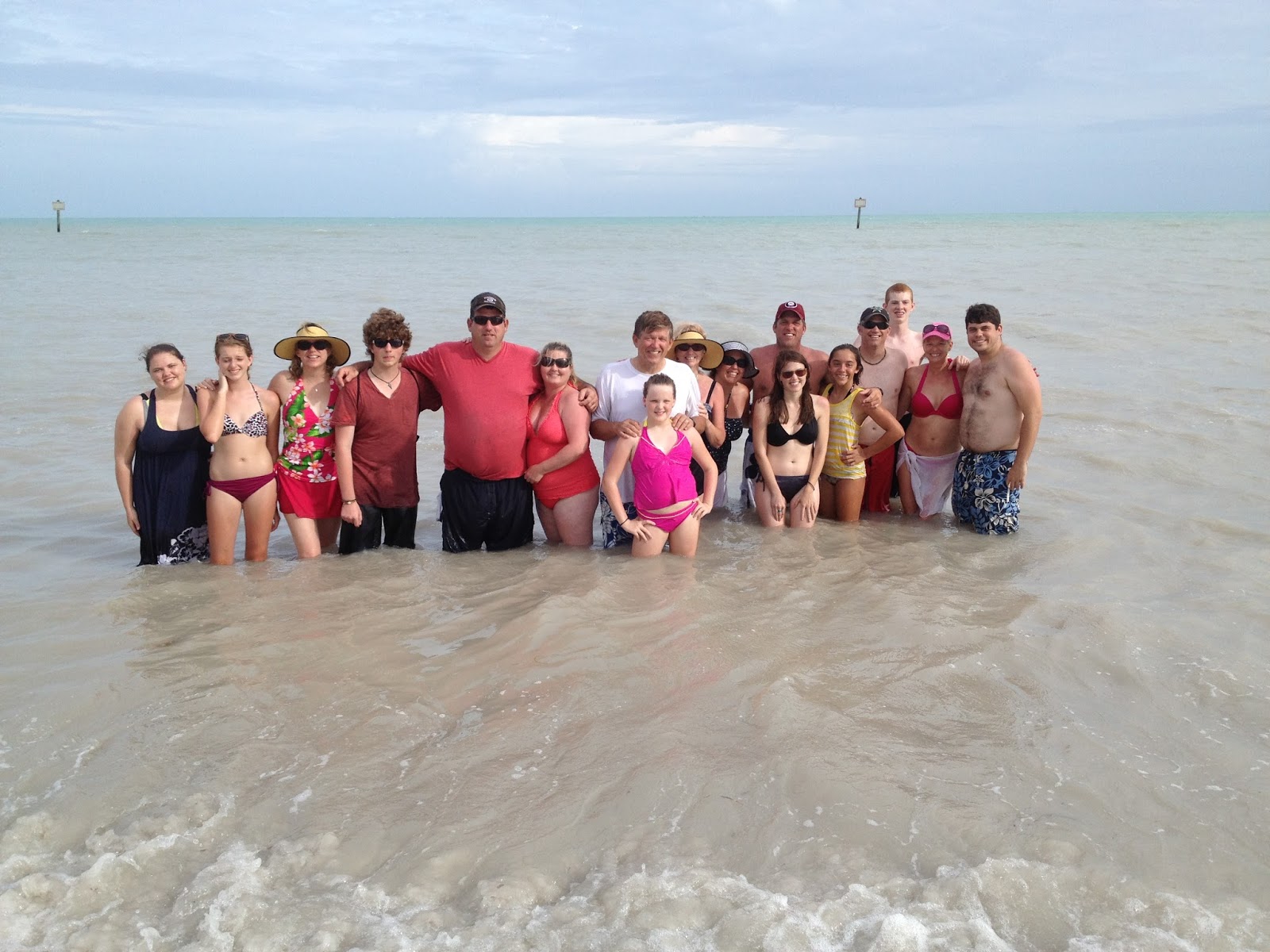
2012 The Florida Keys, Wechsler family Reunion*

2012 Sunset in the Florida Keys

Zoe and I on some beach in the Keys in 2012

2011 the beach house in Myrtle Beach, South Carolina

2011, my mom and I on Myrtle Beach

2011 Galveston Beach,  when Lacey went to the beach for college
2010 Corpus Christi, TX at the Lexington

2009 Pensacola, Florida with the girls


2009 Panama City, Florida para-sailing with my dad

2008 Port Aransas, Texas with Zoe

 
2007, The Comal River
2007 Corpus   


2006 Destin, Florida we loved so much we went 2 years in a row

2005 in Destin, Florida para-sailing with Lacey

2005 Destin, Florida with the extended family*


2005 Hawaii with my girls

2004 in the Florida Keys on a jet ski*

2003, Canyon Lake


2002, Zoe with her feet in the backyard  pool
2001 Myrtle Beach Family Reunion*

2001 Marble Falls. TX
2000, Catalina Island, California with my sister
2000 Catalina Island, California, every picture I took there is postcard worthy


1999, San Diego work trip

1999, hot tub birthday party in lieu of the water's edge

1998 Corpus Christi, home to Texas
1998 Jacksonville, the kids love a good water hose. ;) 
1998 Niagra Falls
1998 St Augustine, Florida
1998 the Mighty Mississippi
1997 (or 98), Virginia Beach
1996 Camping on a lake in Oklahoma
Ariel and Lacey on a Lake mid 90's
Early to mid 90's, a water park would do
1994 or 93 St Louis, Mississippi River


1993 or 94 Ariel and Lacey in the hottub

1993 pregnant at the condo
In the 90's before the beach houses, there was the condo at Canyon Lake, Texas
1992 Ariel on Canyon Lake in Texas

1991- first place we went when we returned from England was a beach: Ormond Beach, FL

1991 Mediterranean Cruise with the ex
1991 an island in the Aegean Sea

1990 Cornwall. England with Ariel

1989 - Dover Beach, even in England we sought out the coast
1988 Ft Walton Beach with a tiny Ariel Marie (3 months omg)
1987 Monterey,  California

1987 Pebble Beach

1987 San Francisco, honeymoon

1986 Miami Beach, age 20, posing 

1986 Jacksonville Florida on my grandpa's boat

1986 my brother liked to throw me in the water
1985 tubing the Guadalupe at night holding on for dear life

1984 Daytona Beach, Florida Family Reunion, age 18


*There are pictures of former boyfriends and spouses of family members but I am not censoring my pictures of them. ;)